
SAMURAI HERITAGE & METALLURGY
The 10-Step
When it comes to golf equipment, the consensus among professional players and connoisseurs is clear: the finest, softest-feeling clubs in the world are hand-forged in Japan. At Dragon Golf, we partner with elite Japanese manufacturers who preserve traditional blacksmithing techniques dating back to the era of Samurai sword-making.
01
Raw Material Selection
The foundation of any premium forged club is the steel. Japanese makers exclusively use high-quality, low-carbon steel manufactured to Japanese Industrial Standards (JIS). The most common grades are JIS S15C and JIS S25C. These steels have a lower carbon content than standard carbon steels, making them exceptionally soft and responsive.
02
Cutting & Heating the Billets
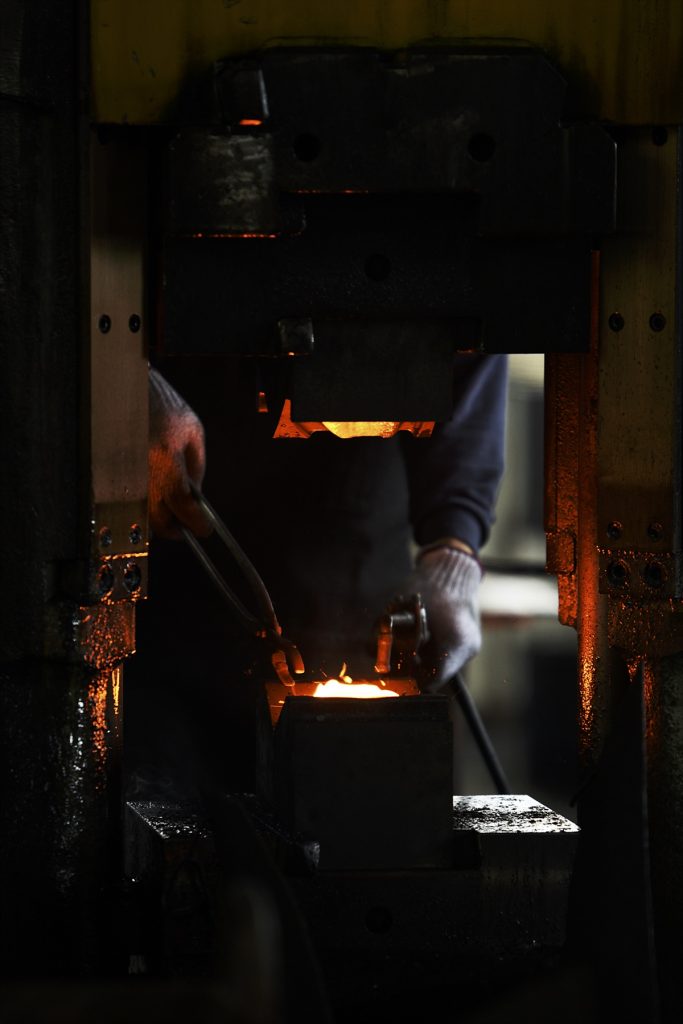
The raw steel is received in long bars, which are cut into precise cylindrical blocks called billets. These billets are then placed into high-temperature furnaces and heated until they are glowing red-hot. This heating process softens the steel, aligning its crystal structure and preparing it to be fed into the forging press.
03
Primary Forging
The heated billet is placed into the first of two forging dies. Under immense pressure from a heavy drop hammer, the steel is stamped. The billet is forged three times across these two dies. This high-pressure stamping forces the steel into the rough shape of a golf club head while compressing the metal’s grain structure.
04
Consolidation Forging & Groove Pressing
The club head is forged once more in a precision finishing die. This step defines the final shapes, sole contours, and face angles. During this stage, the face scorelines (grooves) and manufacturer stamps are pressed directly into the hot steel, ensuring perfect alignment and durable edges that cannot be replicated by machining alone.
05
Trimming and Cooling
As the forged club head emerges from the final press, it has a thin collar of excess metal (called “flash”) around its perimeter. This excess material is trimmed away using a hot-cutting press. Once trimmed, the raw forgings are allowed to cool down slowly in a temperature-controlled environment to relieve internal stresses within the steel.
06
First Grind & Hosel Drilling
Once the raw head is cool, the first grinding process begins. An artisan removes the rough scale and surface imperfections left by the forging process. The hosel (where the shaft inserts) is then precision-drilled. Achieving the exact depth and angle of the hosel is crucial for the club’s eventual loft, lie, and offset.
07
Hand-Shaping & Loft/Lie Adjustment
This is where true Japanese craftsmanship shines. Master grinders (Takumi) use specialized grinding wheels to shape the club head by hand. Unlike mass-produced clubs, which are bent after completion, Japanese manufacturers adjust the loft and lie specifications at this stage—long before finishing, preserving the steel’s structure.
08
Precision Second Grinding
The club head undergoes a second, much finer hand-grinding process. The artisan defines the sharp edges, transition lines, and sole grind. This step determines turf interaction. Master craftsmen like Okamura-san or Takai-san utilize proprietary techniques to create distinct, light-catching grinding tracks.
09
Plating and Surface Treatment
To protect the carbon steel, the head is plated. Options include Galvanic Copper (for ultra-soft feel), classic Chrome Plating (durable, mirror or matte finish), Black Oxide/Boron (low-glare, beautiful wear over time), or Raw Finish (unplated, natural oxidation and patina).
10
Final Finishing & Customisation
In the final step, details are added. Hand-stamped initials, custom engravings, or logos are filled with paint in custom colors. The heads are weighed, balanced, and paired with premium shafts (Basileus, Nippon Shaft) and high-end grips (Cadero).
By adhering to this meticulous 10-step process, Dragon Golf’s manufacturers create clubs that are not merely sports equipment, but individual pieces of art. Experience the difference of authentic Japanese engineering.